Introducing MindsDB v26.0.0 With Improved Agents and Knowledge Bases

Sidney Rabsatt, Chief Product Officer at MindsDB

Martyna Slawinska, Technical Product Manager at MindsDB

A Federated Data & Context Engine for AI Apps and Agents
Building AI applications and agents is no longer just about choosing the right model. The hard part is connecting that model to real, messy, distributed data safely, observably, and in a way that actually fits into production systems.
With MindsDB v26.0.0, we’re doubling down on a clear direction:
MindsDB is the federated query and context engine for AI applications and agents.
This release sharpens MindsDB around the core primitives that matter most to AI app developers:
unified access to data across systems
reliable agents that work directly on that data
and structured, actionable outputs you can analyze or write back
v26.0.0 is a foundational step toward MindsDB acting as a universal Model Context Protocol (MCP) server, a single point where AI systems read from and write to enterprise data with confidence.
Why This Matters If You’re Building AI Apps or Agents
Most AI stacks today still look like this:
pull data from multiple systems with custom pipelines
ship rows into an LLM or agent framework
post-process unstructured output
push results back through another integration
It’s slow, brittle, and hard to trust.
MindsDB v26.0.0 moves this workflow into the data plane:
Query data where it lives
Pass it to agents for semantic reasoning
Analyze the results using SQL
Optionally write results back
That’s the workflow MCP is trying to standardize. MindsDB is making it practical.
What’s New in v26.0.0
This release focuses on three themes that directly improve how developers build AI-powered systems.
1. More Officially Supported Data Integrations
We’ve expanded the set of verified and supported integrations, so you can connect data across your stack without building bespoke connectors.
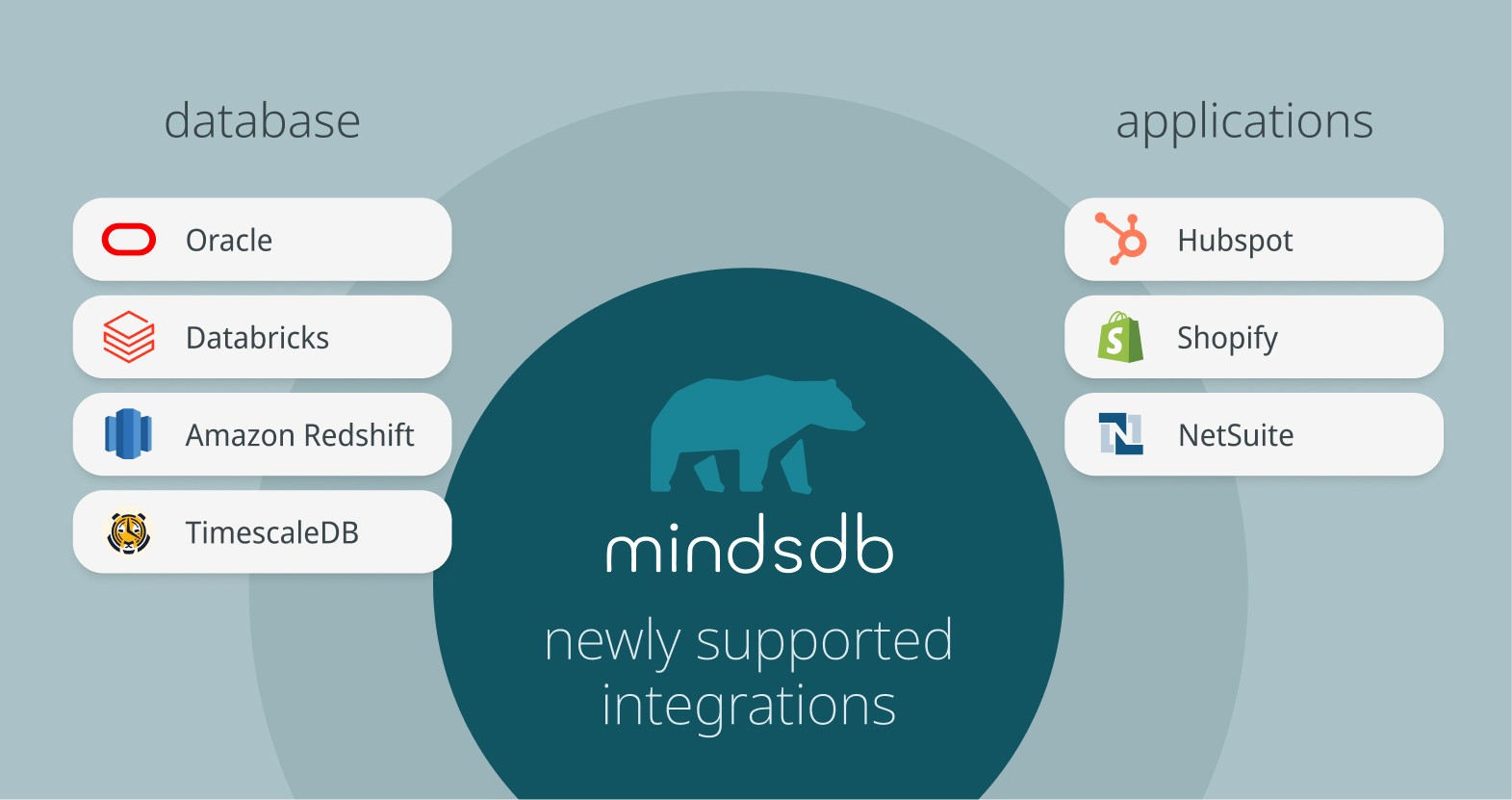
New database integrations include:
Oracle
Databricks
Amazon Redshift
TimescaleDB
MariaDB
New application integrations include:
HubSpot (CRM, tickets, activities, timeline events)
Shopify (products, orders, customers, inventory, marketing events)
NetSuite (SQL access via SuiteQL)
You can query all of these sources using simple SQL, then feed the results directly into AI agents.
2. Faster, More Reliable Agents (Without Changing How You Use Them)
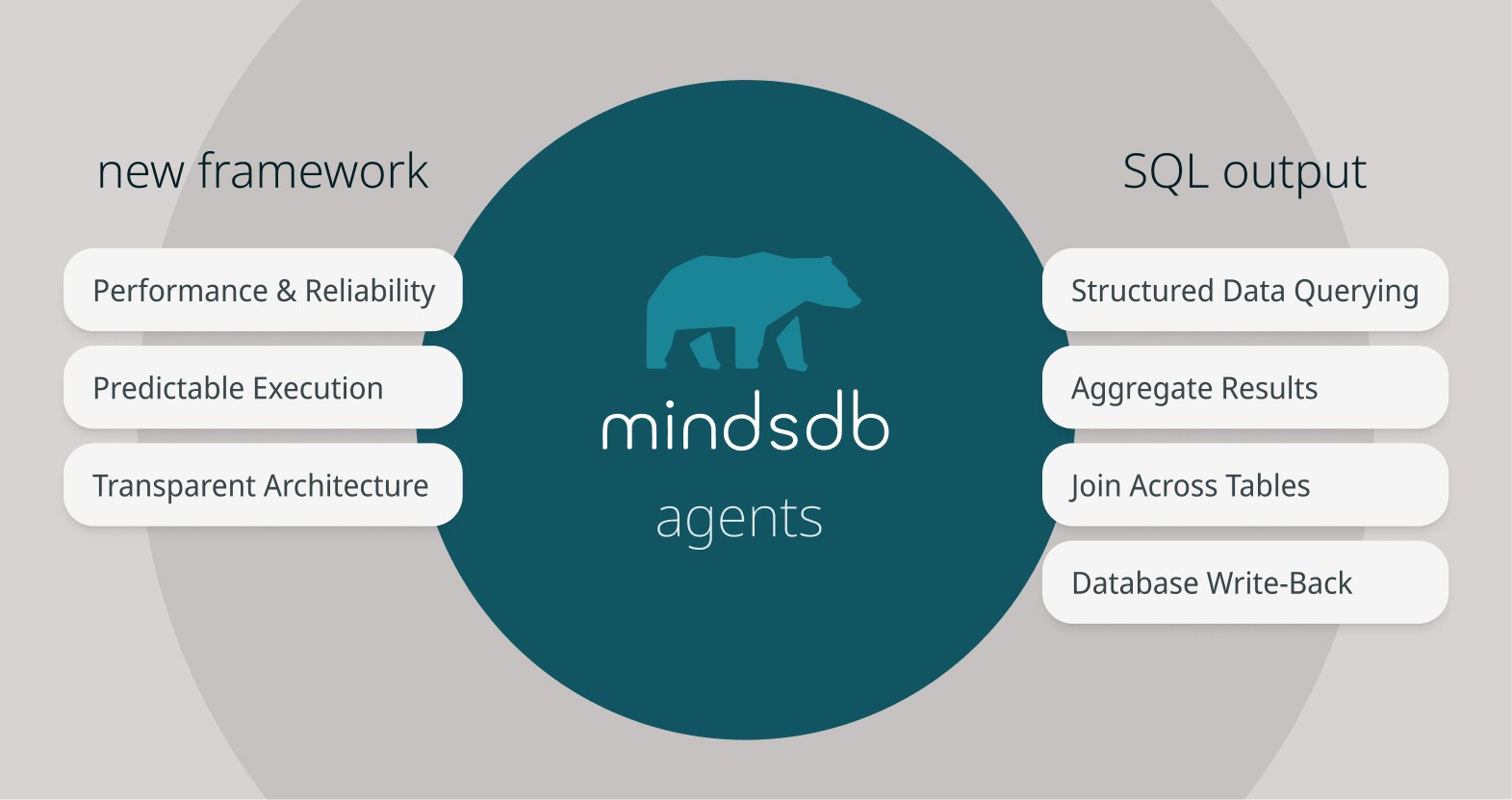
Agents in v26.0.0 are now built on a Pydantic AI agentic framework, replacing LangChain.
What this means for you:
Better performance and reliability
More predictable behavior
Fewer hidden abstractions
What doesn’t change:
Agents are still created with CREATE AGENT
Existing agent workflows continue to work
No rewrite required to benefit from the new foundation
This is a purely structural upgrade that makes agents dependable enough to sit in the critical path of AI applications.
3. Structured, Actionable Agent Outputs — via SQL
One of the most important shifts in v26.0.0 is how agents return results. Instead of treating agent responses as unstructured text, you can now shape outputs using SQL itself.
Example: semantic enrichment + analytics
SELECT product_category, average_sentiment
FROM amazon_reviews_agent
WHERE question = 'What is the sentiment for each product category?';
SELECT product_category, average_sentiment
FROM amazon_reviews_agent
WHERE question = 'What is the sentiment for each product category?';
SELECT product_category, average_sentiment
FROM amazon_reviews_agent
WHERE question = 'What is the sentiment for each product category?';
SELECT product_category, average_sentiment
FROM amazon_reviews_agent
WHERE question = 'What is the sentiment for each product category?';
In this pattern:
You query structured data (e.g. reviews, transactions, tickets)
Each row is passed to an agent for semantic reasoning (e.g. sentiment, classification, extraction)
The agent is guided to return structured columns
You can immediately:
aggregate results
join them with other tables
or write them back to a database
This turns LLM output into database-ready data, not just text blobs.
With this structured output, users can also immediately build dashboards and charts, leveraging a new feature in the MindsDB GUI for simple chart creation.
We think of this as semantic decoration: enriching rows with AI-generated meaning, then continuing to work with them using SQL.
Backward-Incompatible Changes (Read Before Upgrading)
For those relying on the features deprecated below (e.g. LangChain, ChromaDB, built-in ML handlers), MindsDB v25.14.x remains the recommended option.
Agents
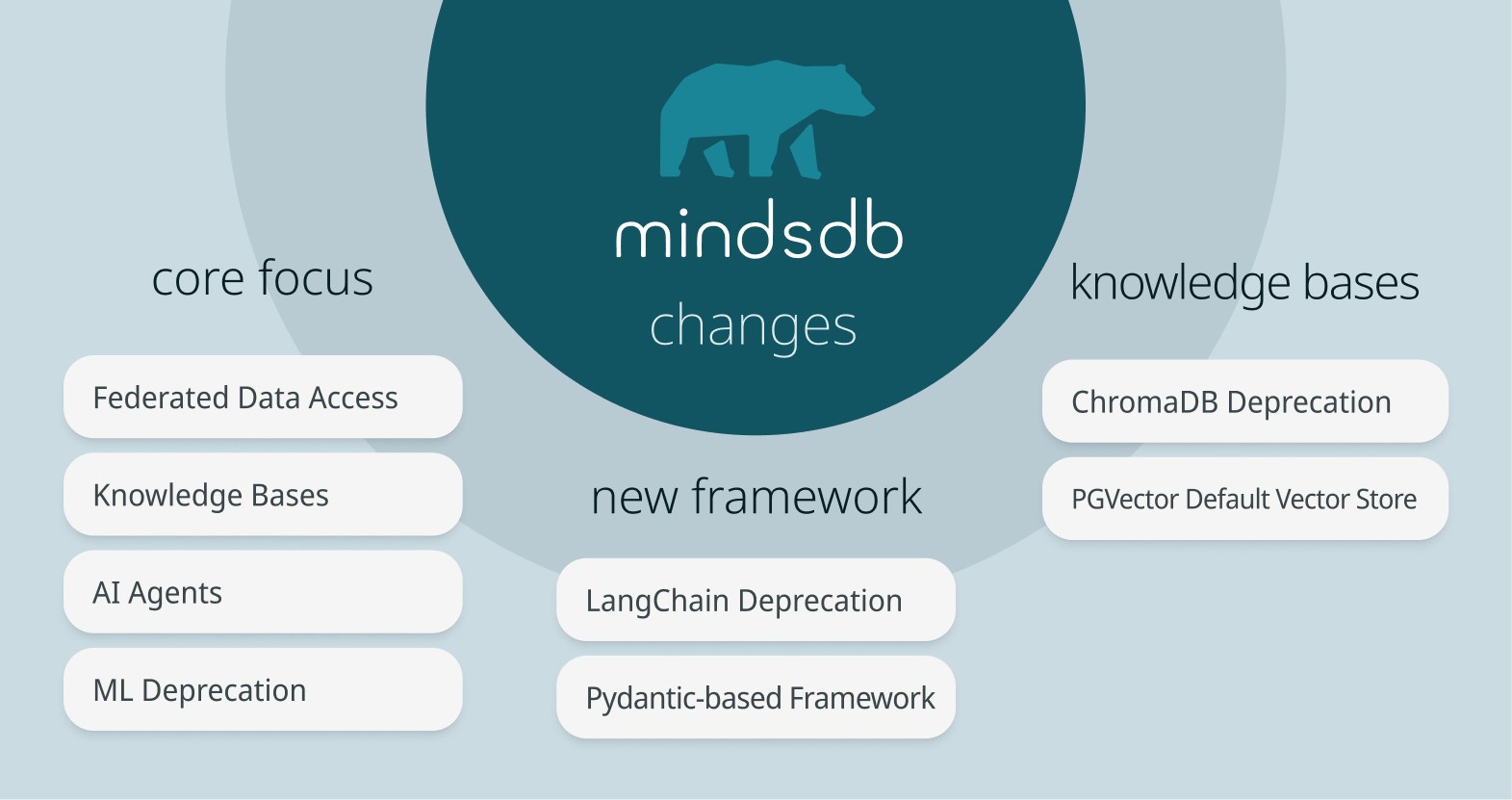
LangChain has been fully deprecated
Agents now run on a Pydantic-based framework
Agent creation and usage syntax remains the same
Knowledge Bases (KBs)
ChromaDB has been deprecated
PGVector is now the default vector store for Docker Desktop
MindsDB via PyPI or Docker image do not have any default vector store
These changes significantly improve KB performance for large-scale ingestion and retrieval.
ML Handlers
Built-in ML integrations (e.g. Lightwood) have been removed
MindsDB now focuses on:
federated data access
knowledge bases
AI agents
If you need custom ML logic, you can still bring your own model (BYOM) and integrate it into agent workflows.
A Foundation for MCP-Style AI Systems
While v26.0.0 is not “a MCP product release” by itself, it deliberately aligns MindsDB around the same core ideas:
a single server that unifies data access
shared context across apps and agents
structured, inspectable tool outputs
safe read and write paths
In upcoming releases, this foundation enables MindsDB to function naturally as a drop-in MCP server that doesn’t just pass context to models, but enables real, governed interaction with data.
Looking Ahead
MindsDB v26.0.0 is about focus and foundations:
Federated access to enterprise data
Agents that operate directly on that data
SQL as the bridge between AI reasoning and production systems
If you’re building AI applications or agents that need to do real work this release is for you.
We’re excited to see what you build.
A Federated Data & Context Engine for AI Apps and Agents
Building AI applications and agents is no longer just about choosing the right model. The hard part is connecting that model to real, messy, distributed data safely, observably, and in a way that actually fits into production systems.
With MindsDB v26.0.0, we’re doubling down on a clear direction:
MindsDB is the federated query and context engine for AI applications and agents.
This release sharpens MindsDB around the core primitives that matter most to AI app developers:
unified access to data across systems
reliable agents that work directly on that data
and structured, actionable outputs you can analyze or write back
v26.0.0 is a foundational step toward MindsDB acting as a universal Model Context Protocol (MCP) server, a single point where AI systems read from and write to enterprise data with confidence.
Why This Matters If You’re Building AI Apps or Agents
Most AI stacks today still look like this:
pull data from multiple systems with custom pipelines
ship rows into an LLM or agent framework
post-process unstructured output
push results back through another integration
It’s slow, brittle, and hard to trust.
MindsDB v26.0.0 moves this workflow into the data plane:
Query data where it lives
Pass it to agents for semantic reasoning
Analyze the results using SQL
Optionally write results back
That’s the workflow MCP is trying to standardize. MindsDB is making it practical.
What’s New in v26.0.0
This release focuses on three themes that directly improve how developers build AI-powered systems.
1. More Officially Supported Data Integrations
We’ve expanded the set of verified and supported integrations, so you can connect data across your stack without building bespoke connectors.
New database integrations include:
Oracle
Databricks
Amazon Redshift
TimescaleDB
MariaDB
New application integrations include:
HubSpot (CRM, tickets, activities, timeline events)
Shopify (products, orders, customers, inventory, marketing events)
NetSuite (SQL access via SuiteQL)
You can query all of these sources using simple SQL, then feed the results directly into AI agents.
2. Faster, More Reliable Agents (Without Changing How You Use Them)
Agents in v26.0.0 are now built on a Pydantic AI agentic framework, replacing LangChain.
What this means for you:
Better performance and reliability
More predictable behavior
Fewer hidden abstractions
What doesn’t change:
Agents are still created with CREATE AGENT
Existing agent workflows continue to work
No rewrite required to benefit from the new foundation
This is a purely structural upgrade that makes agents dependable enough to sit in the critical path of AI applications.
3. Structured, Actionable Agent Outputs — via SQL
One of the most important shifts in v26.0.0 is how agents return results. Instead of treating agent responses as unstructured text, you can now shape outputs using SQL itself.
Example: semantic enrichment + analytics
SELECT product_category, average_sentiment
FROM amazon_reviews_agent
WHERE question = 'What is the sentiment for each product category?';
In this pattern:
You query structured data (e.g. reviews, transactions, tickets)
Each row is passed to an agent for semantic reasoning (e.g. sentiment, classification, extraction)
The agent is guided to return structured columns
You can immediately:
aggregate results
join them with other tables
or write them back to a database
This turns LLM output into database-ready data, not just text blobs.
With this structured output, users can also immediately build dashboards and charts, leveraging a new feature in the MindsDB GUI for simple chart creation.
We think of this as semantic decoration: enriching rows with AI-generated meaning, then continuing to work with them using SQL.
Backward-Incompatible Changes (Read Before Upgrading)
For those relying on the features deprecated below (e.g. LangChain, ChromaDB, built-in ML handlers), MindsDB v25.14.x remains the recommended option.
Agents
LangChain has been fully deprecated
Agents now run on a Pydantic-based framework
Agent creation and usage syntax remains the same
Knowledge Bases (KBs)
ChromaDB has been deprecated
PGVector is now the default vector store for Docker Desktop
MindsDB via PyPI or Docker image do not have any default vector store
These changes significantly improve KB performance for large-scale ingestion and retrieval.
ML Handlers
Built-in ML integrations (e.g. Lightwood) have been removed
MindsDB now focuses on:
federated data access
knowledge bases
AI agents
If you need custom ML logic, you can still bring your own model (BYOM) and integrate it into agent workflows.
A Foundation for MCP-Style AI Systems
While v26.0.0 is not “a MCP product release” by itself, it deliberately aligns MindsDB around the same core ideas:
a single server that unifies data access
shared context across apps and agents
structured, inspectable tool outputs
safe read and write paths
In upcoming releases, this foundation enables MindsDB to function naturally as a drop-in MCP server that doesn’t just pass context to models, but enables real, governed interaction with data.
Looking Ahead
MindsDB v26.0.0 is about focus and foundations:
Federated access to enterprise data
Agents that operate directly on that data
SQL as the bridge between AI reasoning and production systems
If you’re building AI applications or agents that need to do real work this release is for you.
We’re excited to see what you build.
Products
Open Source
© 2026 All rights reserved by MindsDB.

Start conversational analytics with MindsDB
Production-ready infrastructure for agentic analytics
Start conversational analytics with MindsDB
Production-ready infrastructure for agentic analytics

Products
Open Source
© 2026 All rights reserved by MindsDB.

Products
Open Source
© 2026 All rights reserved by MindsDB.
Start conversational analytics with MindsDB
Production-ready infrastructure for agentic analytics